Bol.com
How do you choose a brand name and check whether it’s available?
 Lars HurkmansCo-founder27 October 2026Lesezeit 7 Minuten
If you sell under your own brand on bol, your brand name has to be registered before you add your first product. Otherwise that product stays unbranded. Start with a name that doesn’t describe your product, because you can’t register a name like that. Check with the Naamchecker of the BOIP and the KVK that nobody already uses that name for the same kind of product. After that, registration with the BOIP takes 3 months on average.
In diesem Artikel
Why does your brand name have to be registered for bol?
You can only sell a product on bol as a branded product if it meets bol’s brand guidelines when you add it:
- the EAN is in the name of the brand owner and registered with GS1
- the brand is registered with the BOIP (or the EUIPO or WIPO), in the right class
- the brand is visible on the product or on the original packaging
If your product doesn’t meet these, it is an unbranded product. You can’t turn it into a branded product later. How EAN codes work is explained in the blog on GS1 codes.
Say you want to sell bamboo cutting boards under your own brand. If that goes well, you want to add kitchen knives within a few years. So you are looking for a name that fits both.
Which brand names can’t you register?
If you come up with a brand name that describes your product, you can’t register it as a trademark. Your whole brand has to be distinctive, now and in the future. The BOIP refuses a brand that:
- is descriptive, such as "Fiets" (bicycle) for a bicycle maker or "Biomild" for yoghurt with a mild taste
- is misleading, such as a logo with coffee as a brand for tea
- is only a promotional claim or value judgement, such as "de beste" (the best) or "de lekkerste" (the tastiest)
If the BOIP refuses your brand, you don’t get the application fee back. You then also have no exclusive right to the name.
In its tips for a distinctive brand, the BOIP gives two ways to come up with a name that is distinctive. You choose a word that doesn’t describe your product, such as "Trapjes" (little stairs) for butter cookies. Or you add a distinctive part to a descriptive word, such as the proper name in "Bredewouts koekjes" (Bredewout’s cookies). What is descriptive depends on the product: "Taartjes" (little cakes) describes cakes, but not a graphic design agency.
For your cutting boards, you come up with three names.

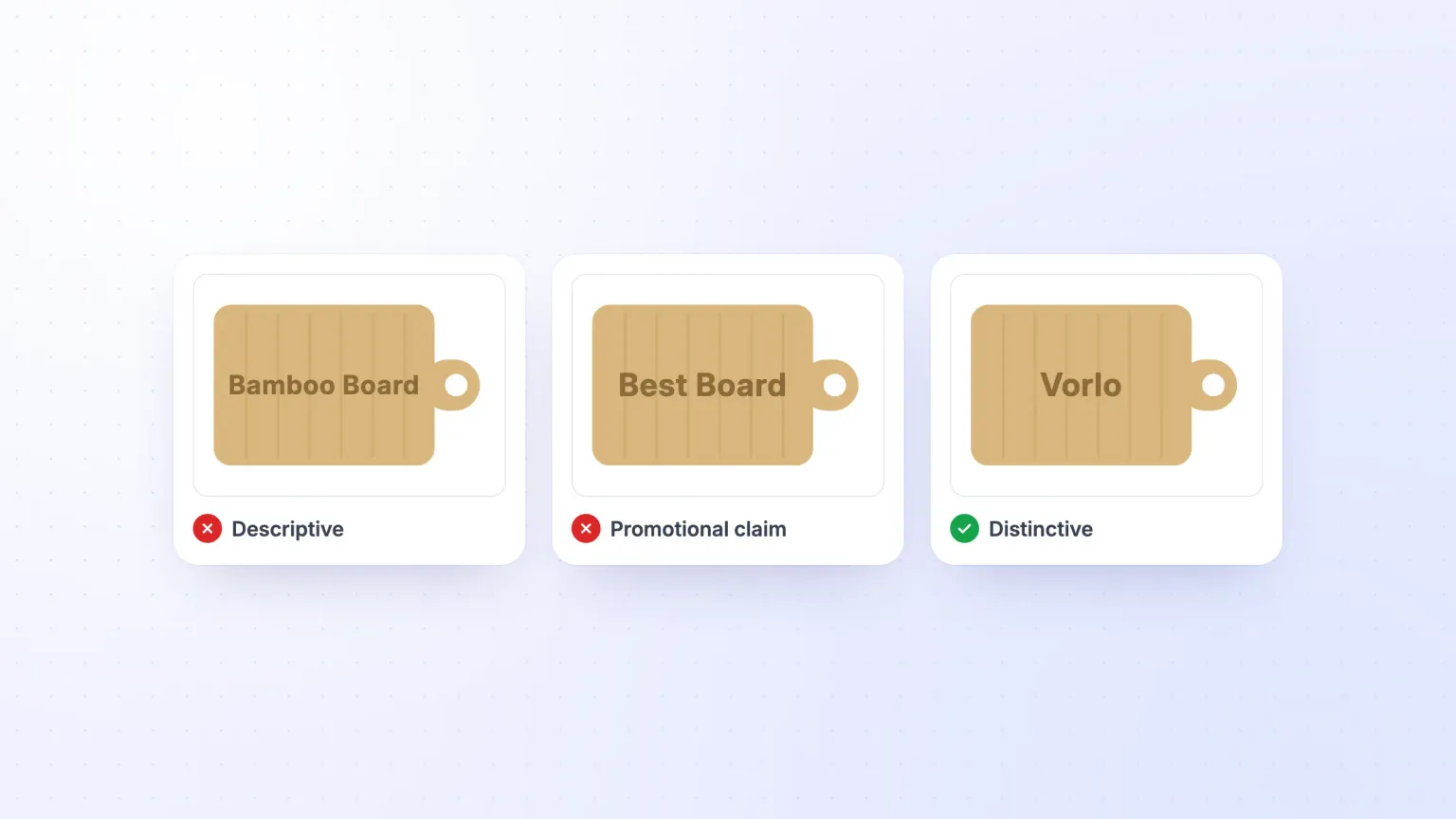
The first, "Bamboo Board", says exactly what you sell. That is descriptive, and the name doesn’t fit the kitchen knives that come later either. The second, "Best Board", is a promotional claim. So you choose "Vorlo", a made-up word that says nothing about cutting boards.
How do you check whether a brand name is available?
You check whether a brand name is available by searching the trademark register and the trade register for the same name and for names that resemble it. You do both in one go with the Naamchecker (name checker) of the BOIP and the KVK (Dutch Chamber of Commerce).
The BOIP advises you to look at the following when you search:
- Variants. Don’t only search for the exact name. The BOIP gives Apple, Aple, Appel and Pomme as an example.
- Sound. The Naamchecker doesn’t search by sound. So search yourself for names that sound the same, such as Daamen, Damen and Danen.
- Parts of your name. Search mainly for the most unique part.
- The products. If you find a brand that resembles yours, check which products and services it is registered for. If the brands are similar and the products overlap, that can be a problem.
- The internet. A name that isn’t in a register can still be actively used in a sector.
A name that already exists doesn’t have to be a problem. According to the BOIP, Ajax exists as a brand for a football club, for fire extinguishers and for cleaning products, because the products don’t overlap. If you also sell outside the Benelux, the BOIP recommends searching TMview, which contains the registers of other countries.

In the example, you search for Vorlo, Vorloo and Forlo. Suppose only Forlo returns something, a brand for clothing. Clothing and cutting boards don’t overlap, just like with Ajax, so Vorlo works. Had Forlo been registered for kitchenware, another name would have been better.
You do this check yourself, because the BOIP only checks whether your name can be a trademark. If your name clashes with an earlier trademark, the owner of that trademark has to raise it themselves. They can object for 2 months after your application is published.
A registration with the KVK doesn’t protect your name as a trademark either. A trade name you actively use is only protected in the region where your business is active.
Your classes depend on your products
Don’t know yet which products you will sell? In the Learning Environment, Lars Hurkmans explains how to work out which product has potential, free during your trial.
Which classes do you register your brand for?
You register a trademark for certain products and services, divided into 45 classes. Classes 1 to 34 are products, classes 35 to 45 services. Your brand is only protected for what you choose.
For bol, the rules on trademark rights set three requirements:
- your brand is in a product class lower than 35, because classes 35 to 45 only apply to services
- the product is also listed in that class under the right goods
- your registration is valid in the Netherlands and Belgium
Retail services are in class 35, so a registration for retail only doesn’t count for bol.
The BOIP advises choosing only classes you will actually use the brand for. If you don’t use the brand within 5 years for everything you chose, someone else can object to that. After your trademark is published, you can’t add products anymore. So if you have concrete plans for the next 5 years, include them straight away.
In the example, TMclass, the EU’s search tool for classes, puts cutting boards in class 21 and kitchen knives in class 8. You also want to sell kitchen knives within a few years, so you choose both. At the BOIP, the first class costs €244, for 10 years. The second class costs €27, and each class after that €81. That makes €271 in total.

When do you register your brand name?
Register your brand name before you put your first product on bol. At the BOIP, the procedure takes 3 months on average. If that takes too long, you can opt for an expedited registration, from €440. With an expedited registration, your brand is entered in the register right away if your application is in order. Only after that does the BOIP check whether your name can be a trademark, and only then can owners of earlier trademarks object. If either goes against you, your registration is cancelled. You won’t get the fees back.
If you put your product online before your brand is registered, it stays unbranded. On the product page you see under the title whether a product has a brand. For a branded product it says "Merk:" (brand) with your brand name, for an unbranded product "Merkloos / Sans marque" (unbranded). The same appears in the specifications.

Once your brand is registered, you fill in the brand name in the brand field when you add your product. Bol wants you to do that in text, even if you only registered your brand as a logo. Use exactly the same spelling for all your products. If you later also register your brand with bol, then bol only protects your product information for products whose brand name exactly matches the one on the registration form.
If only you sell your brand, and not other sellers or shops as well, then according to bol you have a direct distribution channel. In that case the name or logo must be visibly printed on the product or the original packaging. The brand must also be visible on the product photos you put online when you add the product. You agree on your logo on the product and the packaging with your supplier. How to do that is explained in the blog on sourcing from China.
How to register your brand and become brand owner on bol is explained in the blog on trademark registration with the BOIP.
Summary: how do you choose a brand name and check whether it’s available?
- Your brand must be registered before you add your first product. Otherwise that product stays unbranded on bol, and you can’t change that later.
- You can’t register a name that describes your product. The BOIP also refuses promotional claims such as "de beste" (the best), and you don’t get the application fee back.
- You check yourself whether the name is available. Search the Naamchecker of the BOIP and the KVK for the name, parts of it, other spellings and names that sound the same.
- A similar name is mainly a problem for the same kind of products. For example, Ajax brands for a football club, fire extinguishers and cleaning products exist side by side.
- For bol, you register in a product class below 35. A registration for retail only doesn’t count, and your registration must be valid in the Netherlands and Belgium.
Learn from The Silkroad Connection how to find suppliers, free during your trial
14 Tage unverbindlich, ohne Zahlungsdaten.