


Why do bol sellers choose MarktMentor?
  |   | |
|---|---|---|
| Channels | ||
| Set up entirely for bol | Incluido | One of the channels |
| Multiple marketplaces in one dashboard | No incluido | Incluido |
| Connection to your own AI assistant | Incluido | Incluido |
| Market research on bol | ||
| Product database with sales estimates | Incluido | Not available |
| Niche research and analyses on your product selection | Incluido | Not available |
| The entire bol market by category, brand and segment (Panorama) | Incluido | ? Aún no verificado |
| Search volumes per keyword | Incluido | Incluido |
| Findability and market position | ||
| Keyword position tracking | Incluido | Incluido |
| Organic positions and category positions separate from sponsored | Incluido | ? Aún no verificado |
| Share of voice: your share of the search volume | Incluido | Incluido |
| Market share per category | Incluido | Enterprise only |
| Advertising | ||
| Bid automation on bol with strategies, rules and dayparting | Incluido | Incluido |
| Advertising on Amazon, Google and Meta | No incluido | Incluido |
| Profit and store management | ||
| Profit per product and profit and loss statement | Incluido | Incluido |
| Invoices sent to bol automatically and review emails | Incluido | Incluido |
| Stock management | Incluido | Incluido |
| Bol invoices with VAT breakdown | Incluido | ? Aún no verificado |
| Knowledge and guidance | ||
| Knowledge Base and course on selling on bol | Incluido | Webinars and blog |
| bol partner | Incluido | Incluido |
Usado por más de 20.000 vendedores y marcas en bol






































Breadth or depth?
FiveX and MarktMentor are often compared, but they are built to answer a different question. FiveX brings the orders, costs, stock and ads of dozens of marketplaces together in one dashboard. MarktMentor does that for one channel and goes as deep there as the data allows: bol.
A platform for many channels invests in what those channels have in common. Every marketplace has orders, costs and ad spend, and a business that sells on ten channels gains a lot from seeing the margin on all of them in one place. That is a real need, and FiveX is set up for it.
But every marketplace works differently. Bol has its own algorithm, its own category pages, a buy box, its own cost structure, and sponsored products placed between the organic results. If you want to go deep on bol, you need data that only exists on bol. You can only collect it if you build your whole system around it.
That is what MarktMentor does. We track the positions of millions of products on bol, organic separately from sponsored, on keywords and on category pages. We estimate the sales per product, so you can add up a market. And we follow how every category and every brand develops. For us, bol is not one connection among many, it is the whole platform.
Your own figures or the market around them
This leads to a second difference, in approach. A platform that starts from your own orders shows what is happening in your business: what you sell, what it costs and what you keep. You need that. But your own figures do not tell you why your sales are falling, whether the market is shrinking or you are losing ground, or whether a category still has room before you start selling in it.
For that, you need to look at the market around you. MarktMentor puts your own store figures next to those of the rest of your category: your conversion next to the benchmark, your revenue next to the size of the market, your positions next to those of your competitors. That way you see not only what is happening, but also why.
Leer más:The bol market in numbers: where do the growth opportunities lie?
Leer más:How does the bol market work? Traditionals, bol originals and adaptables
How important is bol to your business?
That is the question that drives the choice, more than a feature list. Broadly, there are three situations.
Bol is your main channel
Then you choose MarktMentor, whether or not you use FiveX. The decisions that make or break your margin are then bol decisions: which category you expand into, which keywords you can rank on organically, when you scale back a campaign, and whether a decline is down to you or to the market. For those decisions, you want the deepest data available for bol.
You sell on several channels, but bol carries a lot of weight
Then you use them side by side. In FiveX you track your profit and stock across all your channels. MarktMentor is your platform for bol: that is where you do your market research, follow your findability and market share, and manage your bol ads.
One agreement matters here: let one system automate your bol campaigns. Two systems bidding on the same campaign will push each other in every direction. So choose where your bol ads run, and leave them alone in the other platform.
Bol contributes little to your results
Then the FiveX dashboard is a better fit because of its breadth. If most of your revenue comes from other channels, one overview across all those channels is your most important management tool.
If you still want to keep an eye on the bol market, for example to see whether a category is growing before you invest more in it, you can use MarktMentor alongside it with a lighter subscription. You then get market insight on bol, without the depth you only need once bol becomes a bigger part of your business.
Más de 20.000 vendedores y marcas de bol ya han dado el paso
14 días sin compromiso, sin datos de pago.
What depth on bol means in practice
Market research before you source
For a product you do not sell yet, you have no figures of your own. Your decision then rests entirely on market data. In the Niche Explorer you see, per keyword, the revenue of the products behind it, the search volume, the competition level, the average winning bid and the seasonality. That is a market in one table.
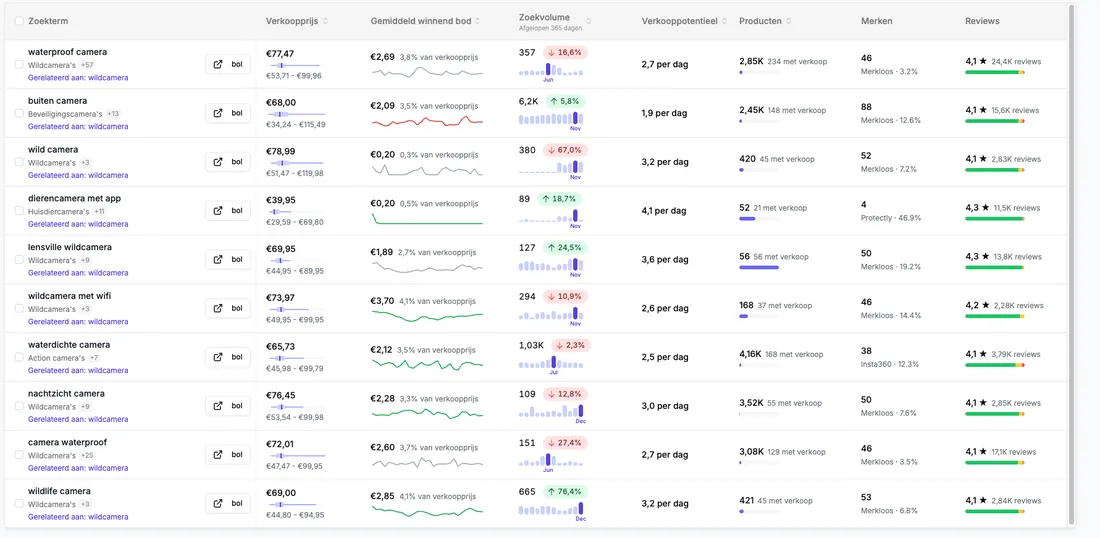
Next, you drill down to products. In the Product Radar you bring candidates together and split them by brand, price range, package size or delivery time. For each segment you see how the trend is moving, how the reviews are distributed, who wins the buy box at what price and delivery time, and how likely it is that a newcomer can still break in. Only then do you work out in the Profit Calculator whether the product leaves anything after all bol costs. If you want to get to the bottom of a single product or competitor, you do that in the Product Database, and the Keyword Guide shows which keywords you should target.
Leer más:Market research on bol: from first idea to sourcing decision
The entire market in view with Panorama
The Niche Explorer and the Product Radar start from a keyword or a selection. Panorama looks at the complete bol market from above, and is built for brands and teams that want to follow their market on a structural basis.
You have three ways in. Through categories you work down from a broad category, up to eight levels deep. Through brands you follow, per player, how many products a brand offers, at what price, with what sales volume and revenue, and how its reviews are doing. And through market segments you look across the category structure, by price range, age, review score or number of sellers, to see where in the market the money is.
When you open a category or brand, eight analyses are ready: the trend in revenue, sales volume, impressions and price, the products, the brands and the subcategories, the reviews, the visibility per keyword, how newcomers have fared in this market, and who takes the buy box and with what. That way you see whether a drop in your own revenue is down to you or to the category, and which competing brands are gaining ground. Panorama is available as an add-on; the terms are on the pricing page.
Leer más:Market analysis on bol: is there room for a new player?
Findability: what you build yourself and what you buy
80% of consumers on bol do not look beyond the first page. Where you rank therefore determines what you sell. In My Rankings you see your positions per keyword and per category page, with sponsored positions shown separately from organic ones. If you see position 5 in a combined figure, you do not know whether you built that spot yourself or are buying it. When deciding whether you can scale back a campaign, that is exactly the figure you need.
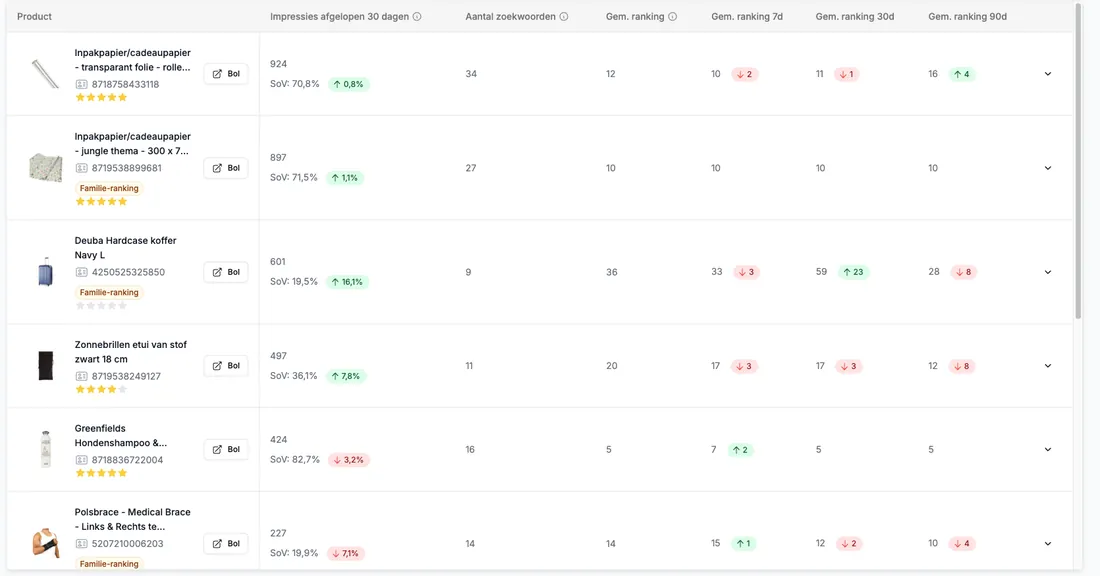
You do not need to build a keyword list for this. Because we already track the positions of millions of products, the history is there as soon as you connect your store, and you can just as easily see which keywords your competitors are found on.
Leer más:Rankings on bol: why you should not rely on a single source
Your market share per category
A revenue figure without a benchmark says little. The same growth can be good news in a shrinking category and disappointing in a category that is growing much faster. MarktMentor calculates your market share per category on bol, and shows which competing brands are gaining or losing ground.
Your bol data in your own AI assistant and systems
Deep data only has value if you can also reach it where you work. You connect your MarktMentor account to your own AI assistant, such as Claude, ChatGPT, or Claude Code, Codex and Cursor. You log in through MarktMentor, and the assistant then works within the permissions of your account.
You ask your question in plain language, and the assistant retrieves the figures itself: your revenue, costs, profit, stock and reviews per product, your organic positions per product, category and search term, and your ad performance down to the level of search term, placement and auction. With advertising access, it also prepares changes, from a bid or daily budget to a bid rule, dayparting or an entire strategy. Nothing goes live without your approval, and you see in advance what a change affects. You can see how that works on our page about the AI assistant; the connection guides are in the help centre.
FiveX and MarktMentor in the same assistant
You can also connect FiveX to an AI assistant, through an MCP connection. If you use both platforms, you link them to the same assistant, and combine the breadth of one with the depth of the other in a single question. For example: which products have a healthy margin across all my channels, but are not yet on the first page organically on bol? Or: on which bol search terms am I paying for visibility I already have organically, and what does that do to my margin across all channels?
This way the FiveX overview becomes stronger with MarktMentor's bol data, without you having to put figures from two dashboards side by side by hand.
Advertising on bol: where we do overlap
There is one area where the platforms genuinely overlap: ad automation on bol. Both work with strategies per product, rules and dayparting. Advertising is also a strong point of FiveX, which also covers Amazon, Google and Meta.
Automation is only as good as the data that drives it. An advertising tool knows your campaigns. MarktMentor also knows the market those campaigns run in, and your competitors in it. You see that at every stage: before you start, while you bid and when deciding when to stop.
Before you bid: what does visibility cost here?
In the Niche Explorer you see the average winning bid per keyword, next to the search volume and the revenue behind it. So you know what visibility on a keyword costs before you set up a campaign for it. When you choose a strategy, you see the volume, the average winning bid and the starting bid per target, so you do not start with a guess that you then spend weeks correcting.
Does your product convert well enough to advertise?
An ad sends visitors to your product page, but the page itself does the selling. That is why you see your product's conversion next to the benchmark for your category. If your product stays below it, you get more out of improving your listing than out of higher bids, because extra traffic to a page that converts poorly mainly increases your costs. If a product's conversion drops in a running strategy, you get an alert about it.
While you bid: how are you doing in the auction?
Per product and per placement type, from search results to category pages and product pages, you see how often you win the auction, what share of the impressions you capture and what the average winning bid is. That way you see whether you are falling behind because you bid too low or because the competition in that spot is simply strong.
You also see when customers in your category buy: the sales patterns per hour and per day of the week, as a benchmark next to the orders for your own product. Your dayparting uses the two together, with a heatmap per two hours that shows when orders actually come in. And the performance data refreshes roughly every two hours, so bid rules can be tied to hours of the day: scale up when your revenue peaks, scale back in the hours when you mainly buy clicks.
What are your competitors doing while you advertise?
That is market data too. Because we track the positions of millions of products, sponsored separately from organic, you see not only your own spot on your keywords, but also which competitors are there and how they got there. If a competitor has won a keyword organically, you are bidding against a strong position. If they are only buying that spot, you can beat them as soon as you become stronger organically or they cut back their budget.
You also see where your competitors are rising or falling, and in the Keyword Guide which keywords they are found on and you are not. Those are your candidates to sponsor. This way you steer your bids on how the competition actually operates on a keyword, rather than only on your own ACoS.
When do you stop: what do you already have organically?
Take a rule that says: stop advertising if I already rank high organically. It is only usable if your organic position is measured separately. Because MarktMentor tracks organic and sponsored separately, the strategy for organic growth can scale back as your organic position gets stronger, and step up where you rank low organically on high search volume.
So the question is not whether you automate, but what you automate on. You can read how the strategies, rulesets and dayparting work in detail on our page about advertising on bol.
Leer más:How does bol's advertising system (Sponsored Products) really work?
Más de 20.000 vendedores y marcas de bol ya han dado el paso
14 días sin compromiso, sin datos de pago.
Knowledge that is only about bol
Because we only focus on bol, our knowledge is only about bol too. Our Knowledge Base is freely accessible and continuously updated, from your first product to the regulations you need to comply with.
On bol, knowledge only stays valid as long as the rules it rests on. When bol tightened its detection of the shopping cart method in November 2024, part of the common explanation of sales estimates became outdated in one go. That is why we cover current developments with people who sell on bol themselves, through the MarktPraat podcast and our webinars. On YouTube there is also a free series on market research on bol, no account needed.
Being fair about FiveX
FiveX is a serious platform and, like us, a bol Gold Partner. A business that sells on many marketplaces at once gets one overview of profit, stock and ads across all those channels, and can have its ad management handled for it if it wants. If bol contributes little to your results, that is a logical choice.
If bol is an important channel, depth counts for more than breadth. Then you want to be able to follow the whole market, per category and per brand, see your organic position separately from what you buy, know whether a decline is down to you or to the market, and have ads that are driven by that data. That is what MarktMentor is built for. And if you already use FiveX, you do not have to choose: MarktMentor works alongside it as your platform for bol, and the two come together in your AI assistant.
Try it free for 14 days, with full access and no obligation to pay. Our rates are on the pricing page.
Leer más:How LifeGoods uses MarktMentor for revenue growth and competitor analysis on bol