

Why do bol sellers choose MarktMentor?
  |   | |
|---|---|---|
| Product research | ||
| Product database with market data | Incluido | Incluido |
| Exact sales estimates per product | Incluido | Not available |
| Niche research at keyword level | Incluido | Limited |
| Building your own analyses on your product selection | Incluido | Very limited |
| Chrome extension | Incluido | Limited |
| buy box analysis per seller over time | Incluido | Not available |
| Cohort analysis of new entrants | Incluido | Not available |
| Market share analyses | ||
| Market share per category | Incluido | Not available |
| Share of Voice: your share of the search volume | Incluido | Not available |
| Competing brands and their development | Incluido | Not available |
| Findability on bol | ||
| Tracking keyword positions | Incluido | Incluido |
| Organic positions separate from sponsored | Incluido | Not available |
| Organic impressions per keyword and category page | Incluido | Not available |
| Listing optimisation | ||
| Writing listings with AI | Incluido | Incluido |
| Keyword research with labelled relationships | Incluido | Not available |
| Advertising | ||
| Advertising insights with ACoS and TACoS | Incluido | Basic |
| Bid automation with rules and dayparting | Incluido | Incluido |
| Bid rules on hours of the day | Incluido | Not available |
| Dayparting based on your own order pattern | Incluido | Set up yourself |
| Steering bids on your organic position | Incluido | Not available |
| Strategies per product phase | Incluido | Not available |
| Profitability | ||
| Profitability per product | Incluido | Incluido |
| Store management | ||
| Inventory and order management | Incluido | Incluido |
| Review emails and automatic invoices | Incluido | Incluido |
| Bol invoices with VAT breakdown | Incluido | Not available |
| Knowledge and guidance | ||
| Course material and Knowledge Base | Incluido | Very limited |
| Knowledge and support in-house | Incluido | Outsourced |
| bol partner | Incluido | Incluido |
Usado por más de 20.000 vendedores y marcas en bol






































Separate features or one system underneath?
The table above shows where the platforms overlap and where they don't. Almost all of those differences come back to the same point: whether the components sit on the same data.
Take a question you have regularly: on which keywords can I stop advertising? For that you need three things at once. Your organic position per keyword, separate from your sponsored visibility. Your advertising costs per keyword. And the search volume behind it. If that data sits in separate features, you export three lists and put them side by side in Excel. If it sits on the same data, it is one view.
That is how it works for every decision that costs money. Does this niche still have room? Which product leaves something over at the bottom line? At which hours is this product bought? Below we walk through those steps, from your first product choice to your advertising.
Product research on bol: how reliable is the data?
The first thing sellers look at: how many products are in the database? How accurate are the sales estimates? Fair questions. But there is a question that comes before them: how is that data collected?
For years the shopping cart method was the standard. In November 2024 bol tightened its detection of this technique. At Rylee the display has since changed several times: specific sales estimates have been replaced by ranges, and it is unclear whether the current data is based on the same method. MarktMentor moved away from the shopping cart method early on and works with its own method. The tightening by bol had no impact. That means: several years of uninterrupted historical data, specific sales estimates per product, and a consistent display.
But product research is more than a database. MarktMentor approaches the market from three perspectives: categories (market size, conversion, returns, seasonal patterns), keywords (search volume, competition, advertising costs) and products (sales, price development, reviews, visibility). You start with a keyword, discover products, and save your selection to analyse: from broad to specific, within the same environment. The database contains more than 5 million relevant products, growing daily.
Why ranges block your research
Good research starts with the market, not with a single product. You first assess whether a whole niche is promising and only then drill down to one product. That requires data you can add up.
And that is where it gets stuck. Rylee gives units sold in ranges: not an estimate, but between 10 and 25, or between 25 and 75. For one product that gives a reasonable impression, but ranges cannot be added up. If you want to take twenty products together to see how big a market is, the uncertainty stacks up until the total no longer tells you anything. As a result you are not working less precisely, you are skipping a whole research step. And the question you skipped, is this market worth it, is the most expensive one to get wrong.
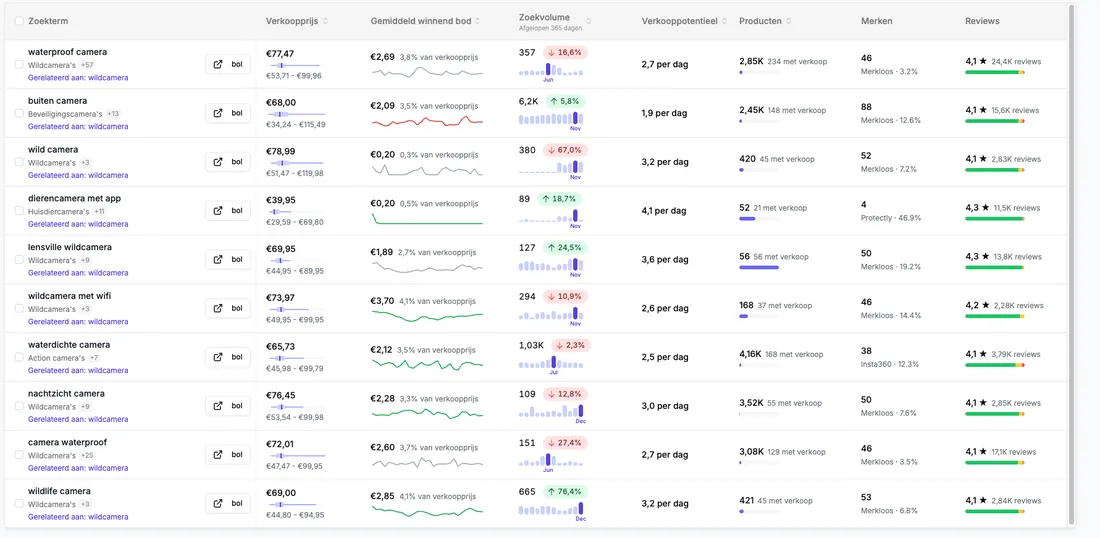
MarktMentor gives exact estimates per product, precisely so you can aggregate them. In the Niche Explorer you see per keyword the total revenue of the products behind it, the search volume, the competition level, the average winning bid and the seasonality. That is a market in one table instead of a product in a row.
Leer más:Why doesn't the shopping cart method work on bol anymore, and what are the consequences for Rylee?
Leer más:How do you choose a product research tool for bol?
Leer más:Market research on bol: from first idea to sourcing decision
From a list of products to an analysis
You now have a collection of candidates, and that is where most tools stop. Rylee has a way to follow products, but in essence that comes down to a saved list: what that collection tells you, you work out yourself in a spreadsheet.
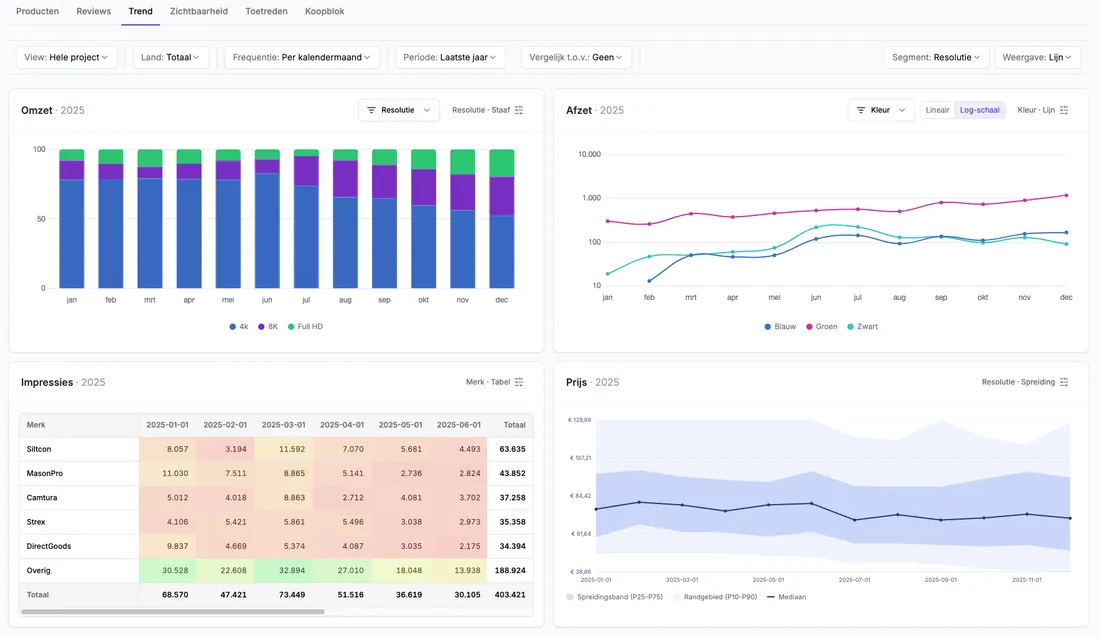
In the Product Radar your selection is the starting point of the analysis instead of the end point. You decide yourself how to segment it, by brand, price range, package size, age or delivery time, and where the boundaries of such a range lie. You save those segments, so you can come back to them later.
Complete analyses then run on each segment, and that is where a list becomes research. You see the trend of revenue, units sold, impressions and price over time, including the spread. You see the reviews across the whole market and the visibility per keyword and category page. For the buy box you see per seller the share, the price and the delivery time over the weeks, so you know whether to compete on price or on delivery time. And in the cohort analysis you put start periods side by side by age instead of by calendar date, and see whether entering this market is getting harder.
How you work through a niche from first idea to sourcing decision, and how the Radar's analyses build on each other, is worked out step by step in the full comparison.
Leer más:MarktMentor vs Rylee: how do you do product research on bol?
Findability on bol: organic or sponsored?
80% of consumers on bol don't look beyond the first page. If your product is not visible, you sell nothing. To know where you stand, you need to track your positions. This is where there is a concrete difference.
Bol shows basic ranking information in the seller account, but without distinguishing between organic and sponsored positions. Rylee essentially does the same: a combined position in which organic and sponsored are mixed together. If you see position 5 there, you don't know whether that comes from your organic performance or from paying for it.
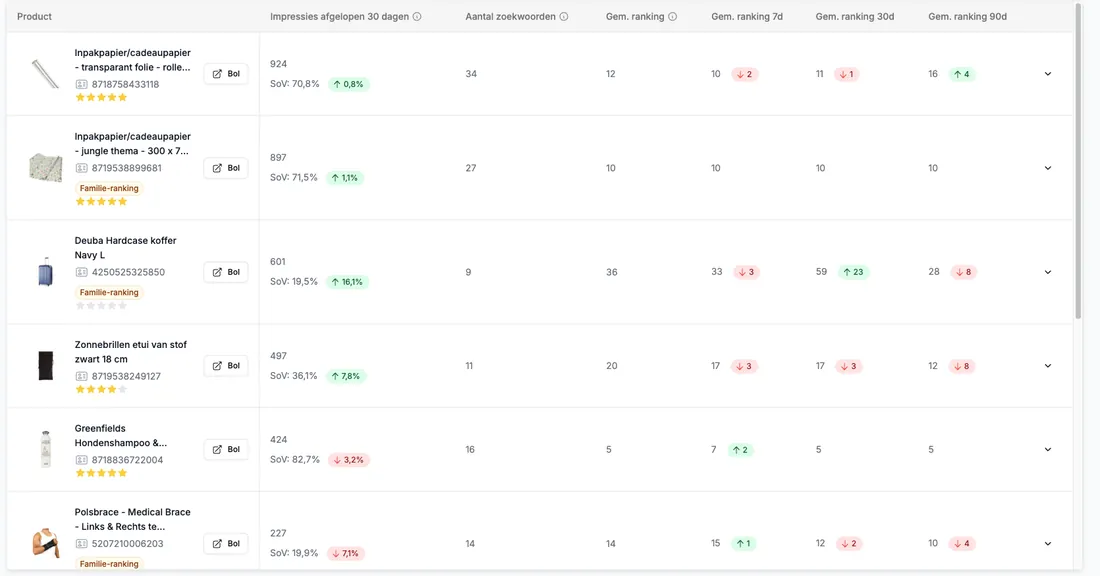
MarktMentor measures purely organic positions, separated from sponsored. Per keyword and per category you see your exact organic ranking, the historical development over time, your Share of Voice (what percentage of your potential customers you reach), and how many of your impressions come from advertising. So you do see how much you advertise, but that data doesn't cloud your organic positions. That distinction is crucial for your advertising strategy: you don't want to pay for positions you already have organically. Positions are tracked automatically as soon as you connect your store, without manual setup.
Improving your listing with the data you measure
Monitoring positions is only half of it. You also want to use that data to improve your product page. Which keywords are relevant for your product type? How competitive are they? Which keywords bring your competitors traffic? MarktMentor lets you answer those questions and translates those insights into a listing optimised for both the bol algorithm and Google Shopping, based on real keyword data, competitor analysis and review insights.
Leer más:Rankings on bol: why you should not rely on a single source
Leer más:Findability on bol: how it works and how you improve it
Leer más:MarktMentor vs Rylee: how do you measure your findability on bol?
Leer más:MarktMentor vs Rylee: how do you optimise your listing on bol?
Market share analyses: where do you stand in the market?
When you sell, you want to know whether you are growing, and whether you are growing faster than the market. MarktMentor combines your own store data with market-wide estimates. Per category you see your market share, its development over time, and which competitors are gaining or losing ground. Your conversion is compared with the benchmark of your category. That way you know not only how you perform, but how you perform relative to the rest. Revenue that looks high can be less than one percent share in a large market, and a conversion that seems low can be perfectly fine if the whole category converts low. Without that context you make decisions on half the information, and that context, benchmarks and market share, is something a tool that only passes through your own figures cannot provide.
Reviews are tracked automatically. Per product, but also across your whole assortment. You see patterns: which aspects are consistently mentioned as a strong point, and where customers keep running into problems. Those insights help you improve your products and decide what to scale and what to stop.
An important point: the platform you choose now determines what data you will have in a year. Historical data on your performance, positions and market share builds up from the moment you start. You cannot add it afterwards.
Leer más:Why historical data protects you against poor product choices on bol
Profitability per product on bol
On bol you pay five cost components per product: purchasing and shipping, bol commission, advertising costs, storage and returns. Those costs differ per product, per category and per shipping method. Many sellers overestimate their profitability because they don't include all costs.
Return costs are underestimated most often. In some categories more than 1 in 7 sales is returned. That costs you not only the return shipping, but also the refund, any damage to the product, and restocking. The difference between the highest and lowest return categories can be as much as a factor of 25. If you don't take this into account, you may think you are making a profit while in reality you are running at a loss.
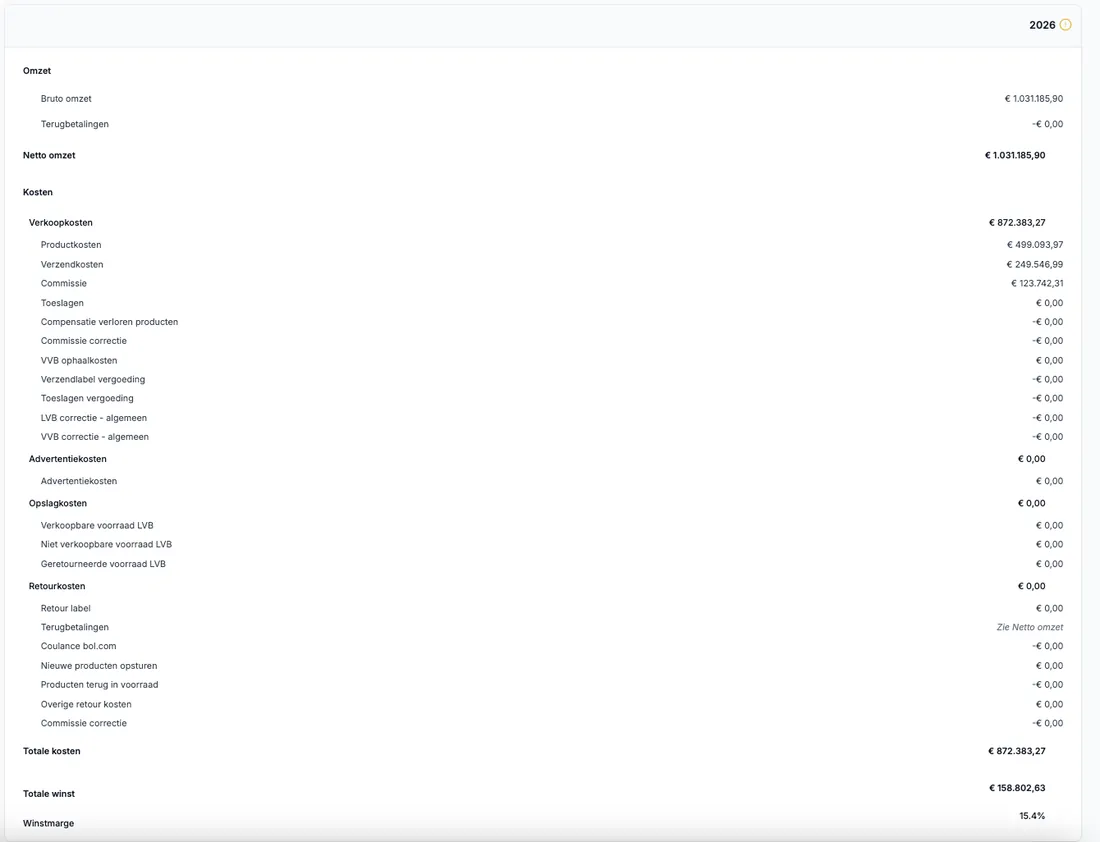
MarktMentor automatically calculates all five components per product, based on the data from your connected bol store. Per product you see what you keep net after all costs, sorted from most to least profitable. At store level there is a full profit and loss statement per period, from gross revenue to net profit with all costs visible. That way you know which products are your real money makers and which ones cost you money.
What you keep at the bottom line also has to add up in your bookkeeping. And the VAT return on your bol revenue takes more time than necessary, especially if you sell in several countries or at several VAT rates. With the VAT invoices you see per quarter your output VAT broken down per country and per rate, your deductible VAT per cost group such as commission and fulfilment, and the balance between them. We calculate that breakdown from the orders behind your bol invoices. Per invoice you see the source data and whether the data is complete, and you export the whole calculation for your accountant.
Invoices count towards the year and quarter of the issue date and not of the invoice period. The latter determines in which quarter an amount lands, and therefore whether your figures match the period you are filing for. Always have your return checked by your accountant.
Leer más:Which costs determine your profitability on bol?
Leer más:MarktMentor vs Rylee: how do you grow profitably on bol?
Advertising on bol: what does the automation steer on?
For almost every product, advertising is indispensable to get going. But it is a means, not an end: you buy visibility to build your organic position, and then scale it down. The whole skill lies in that scaling down. Stop too early and you lose your position; continue too long and you pay for months for a spot you already had.
Both platforms have bid automation with rules and dayparting. The difference is not in those features, but in who does the thinking. A tool you have to fill in yourself hands the guesswork back to you, just with a nicer interface around it.
A rule that says "stop advertising if I already rank high organically" is only usable if your organic position is measured separately. Rylee reads the positions from the bol API endpoint, just like the seller account. On a keyword where sponsoring takes place, that position is already a weighted mix of organic and paid impressions. Such a rule therefore assesses a number that contains the very ad it is supposed to switch off. If you are in position 3 because you pay for it, the rule sees position 3, concludes that advertising is no longer needed, and your product drops as soon as the campaign stops. That is not automation, that is a circle.
MarktMentor measures the organic position separately from sponsored visibility, and does not take it from the same API endpoint. From the bol API we also read whether impressions come from ads or not, so you have two separate layers side by side. That is something automation can steer on: scaling down where you already rank strongly organically, adding where you rank low organically on high search volume.
From figures to actions you can roll out
The rest builds on those two layers. You choose a strategy that fits your product's phase, from launching to optimising, which adjusts campaigns and bids itself based on performance. You put rulesets on existing campaigns, with a preview so you see in advance what will happen instead of afterwards. Your dayparting starts from a data-driven template generated from the product's order pattern, which you then adjust yourself, because when your products are ordered differs per category. And with the bulk editor you roll out across your whole store what works on one product.
One property determines whether it also works on time: the frequency. If your rules run on KPIs that refresh once a day, you are reacting to yesterday. Our performance data is updated roughly every two hours, so bid rules can be tied to hours of the day: scaling up when your revenue peaks, scaling back in the hours when you mainly buy clicks. That is the difference between adjusting on the day itself and running a day behind the competitor who already does that.
So the question is not whether you automate, but on what. If you automate an assumption, that assumption only becomes faster and more expensive. If you automate on your own figures, every rule gives you something back: hours you don't spend in Excel, and budget that no longer goes to positions you already had.
14 días sin compromiso, sin datos de pago.
Knowledge about selling on bol: current or outdated?
Tooling is a means, not an end. You need to know which decisions you have to make and why. This is where MarktMentor sets itself apart.
On YouTube there is a free series on market research on bol. Ten chapters, from common mistakes to profit calculation. Two example products are followed from start to finish. The series is free, requires no account, and shows you whether selling on bol is something for you.
The Knowledge Base continues where the YouTube series stops. There you learn step by step how to successfully sell your first product: how to find suppliers and communicate with them, what to look out for when you bring products to the Netherlands, which regulations you have to comply with, and more. Current topics are covered through the MarktPraat podcast and webinars.
Want to see what is possible when you take this process seriously? In our documentary you follow TLS Commerce, the company behind top 50 brand Nuvance, from product research to €5 million in revenue on bol.
Honest about Rylee
Rylee is a fine first step if you want to start following products on bol. The starting price is comparable and you are up and running quickly.
It starts to pinch as soon as your questions become more compound. Then separate features give separate answers, and the combining is left to you: an export here, an export there, the conclusion in Excel. That is possible, but it is work that doesn't go into your analysis and that you redo every month.
At MarktMentor categories, keywords, products, your store figures and your advertising data sit on top of each other. That is why you can add up specific sales estimates to a market picture, compare several years of uninterrupted history, read your organic position separately from sponsored, and have your advertising steered by exactly those figures.
That is why sellers who want to grow seriously work with MarktMentor.
Leer más:How LifeGoods uses MarktMentor for revenue growth and competitor analysis on bol
What does a wrong decision cost?
At entry level the prices of comparable bol platforms are close to each other. If you come across a comparison in which the difference is a multiple instead of a few euros, look at what is being compared: usually an entry rate against a top subscription.
More important is that your subscription is one of your smallest cost items on bol. Your purchase order is not. A batch that doesn't sell, or a niche that was already closed when you entered, costs you many times what a year of tooling costs. The same calculation applies to advertising you keep bidding on for months while you already ranked high organically.
That is where a platform pays for itself or doesn't. So what counts is not what it costs per month, but whether you can rely on it at the moment you spend money. Do you get specific sales estimates or ranges? An uninterrupted measurement series or a history that switched methods halfway through? Organic positions separate from what you buy, or one combined number? Market data with which you can assess a niche, or only your own figures?
Our current rates are on the pricing page. Try it free for 14 days, with full access to all features and no payment obligation.