

Why do bol sellers switch to MarktMentor?
  |   | |
|---|---|---|
| Product research | ||
| Product database with market data | 包含 | 包含 |
| Niche research at keyword level | 包含 | Limited |
| Build your own analyses on your product selection | 包含 | Very limited |
| Track and save products | 包含 | 包含 |
| Chrome extension | 包含 | 包含 |
| Profit Calculator before you buy stock | 包含 | 包含 |
| Market share analyses | ||
| Market share per category | 包含 | Not available |
| Share of voice: your share of the search volume | 包含 | Not available |
| Competing brands and how they develop | 包含 | Not available |
| Conversion against the category benchmark | 包含 | Not available |
| Findability on bol | ||
| Track keyword positions | 包含 | 包含 |
| Organic positions separate from sponsored ones | 包含 | Not available |
| Track category positions | 包含 | Not available |
| Organic impressions per keyword and category page | 包含 | Not available |
| Listing optimisation | ||
| Keyword research | 包含 | 包含 |
| Labelled keyword relationships | 包含 | Not available |
| Write listings with AI | 包含 | 包含 |
| Listing based on bol data | 包含 | Limited |
| Advertising | ||
| Ad insights | 包含 | Basic |
| Manage campaigns from the platform | 包含 | Not available |
| Bid automation with strategies per product phase | 包含 | Not available |
| Rulesets, dayparting and bulk editor | 包含 | Not available |
| Profitability | ||
| Profitability dashboard | 包含 | 包含 |
| Performance per product with ROI and TACOS | 包含 | 包含 |
| Profit and loss statement per period | 包含 | Not available |
| Store management | ||
| Automatic email campaigns for reviews | 包含 | 包含 |
| Upload Customer Invoices automatically, including via Peppol | 包含 | 包含 |
| Bol invoices with VAT breakdown | 包含 | Not available |
| Stock and order management | 包含 | 包含 |
| Knowledge and guidance | ||
| Course material and Knowledge Base | 包含 | 包含 |
| Community | 包含 | 包含 |
| bol partner | 包含 | Not a bol partner |
已有 20,000+ bol 卖家和品牌在使用



































Looking alike is not the same as being the same
On a feature list the platforms look alike. Both have a product database, both have keyword research, both have a profit calculator. But a feature with the same name is not the same feature. The difference is in how far it takes you and whether you can base a decision on it.
Take rankings. Both platforms show which keywords you are found on. With us you also see your category positions, your share of voice, and your organic position separate from what you buy with ads. That last point determines whether you can scale back a campaign without losing revenue. Without that distinction, a position is a number without meaning.
It works like this in more places. Market share, a profit and loss statement per period, analyses on your own product selection and ads that adjust themselves: these are not part of the Zoloo package. Below we go through them one by one, per decision you make on bol.
Product research on bol: where do you start?
With the market, not with a product. A product that looks attractive on its own can sit in a market that is already saturated. That is why you first assess whether a niche has room, and only then narrow down to a single product.
Both platforms have something for that first step. At MarktMentor you search a database of millions of products with sales estimates, price development, reviews and visibility; Zoloo has a comparable database. A niche explorer and a profit calculator are also available on both sides.
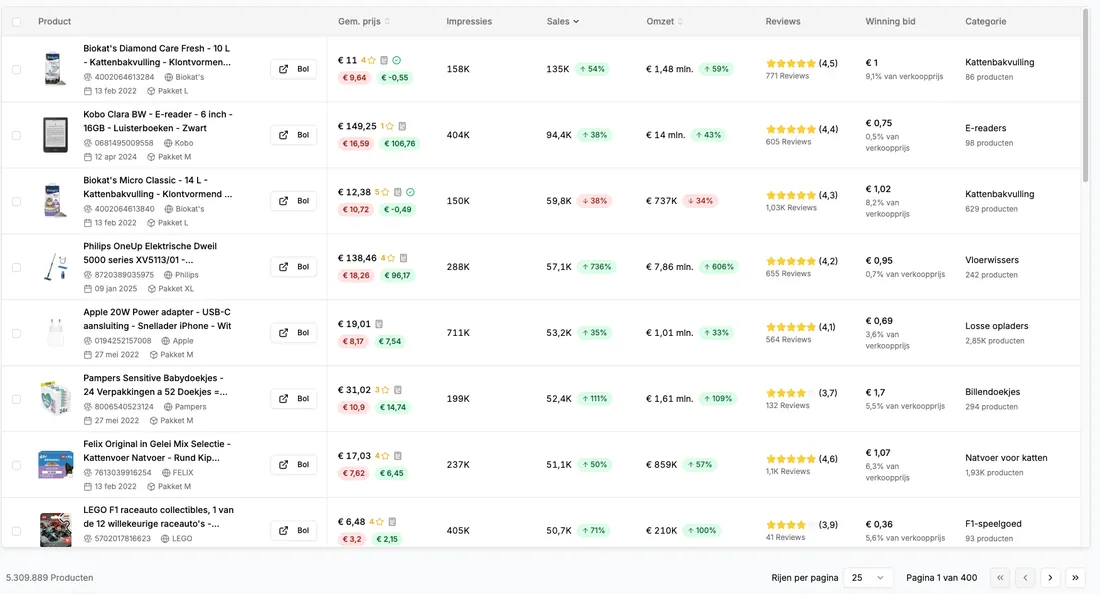
The difference starts with the number of angles. MarktMentor links categories, keywords and products to each other, so you start with a keyword, see which products sell on it, zoom in on the reviews and keep track of your selection. If you also sell in Belgium, you can put the product data from both countries side by side.
Market research: is there room in the niche?
You assess that on demand versus supply. The Niche Explorer is built for this: a filterable database of keywords and categories in which you search by demand, competition and seasonal pattern. That way you first assess whether a market has room, and only then which product fits into it.
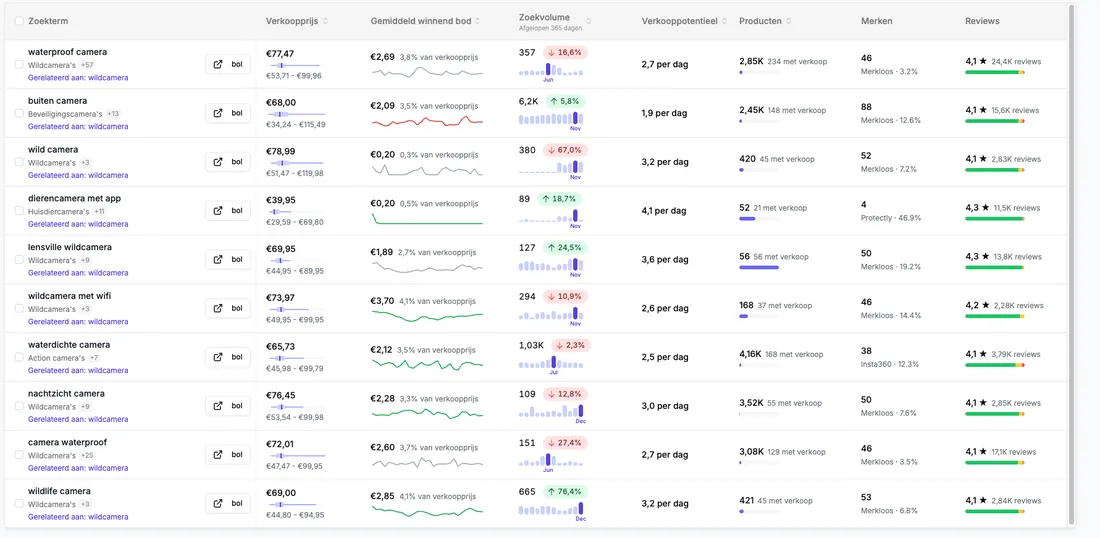
You can also look at that development over time, from the past month to the past year. A niche that looks quiet today may have just had a seasonal peak, and a niche that looks busy may be past its high point. Without that view over time, you judge a market on a single snapshot.
Competitor analysis on your own product selection
You now have a set of candidates, and that is exactly where most tools stop. You can save and track products, but you have to work out in a spreadsheet yourself what that set tells you.
In the Product Radar your selection is the starting point of the analysis instead of the end point. You decide how to divide it, by brand, price range, pack size, age or delivery time, with boundaries you choose rather than fixed bands. On each cross-section you run the same analyses: how the reviews are distributed and where customers run into problems, how the trend is developing, where you are visible, who wins the buy box and at what price and delivery time, and how likely it is that a newcomer can still get in here.
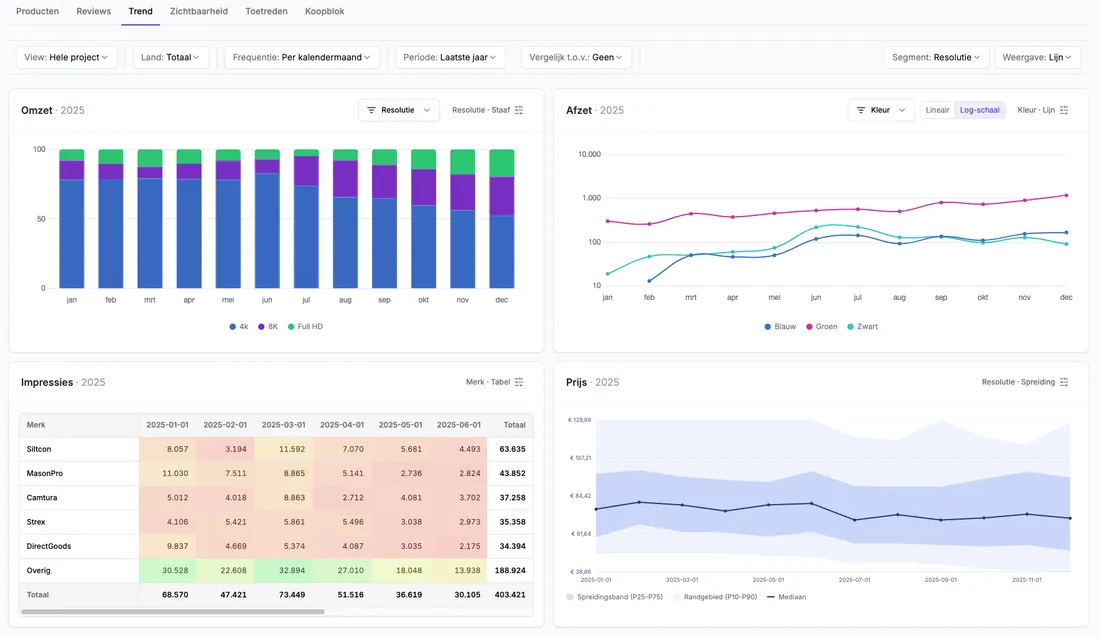
That changes the question you ask. No longer how one product is doing, but in which part of this market there is still room and why. Zoloo has a Product Tracker to save and follow products, but these kinds of cross-sections and analyses are not part of it: there you follow products, here you take a market apart.
Market share analyses: where do you stand in the market?
You can read that from three things: where you are found, how large your share of the market is, and how your conversion compares to your category. Zoloo gives insight into your current findability. MarktMentor adds market share and a conversion comparison to that, so you see not only what you are doing yourself but also how that compares to the rest of your category.
Findability on bol: where do you stand now?
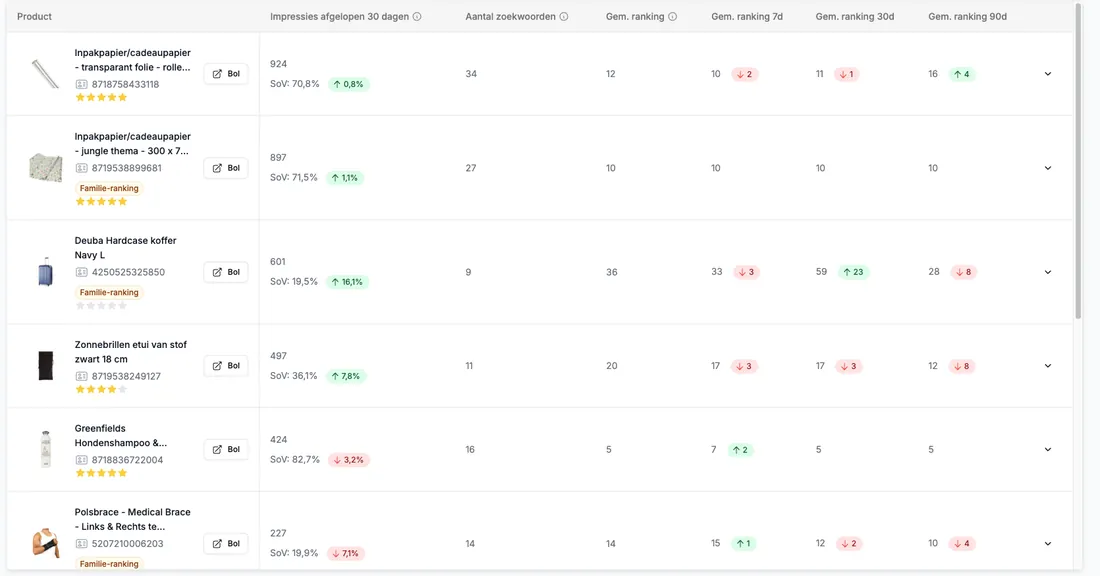
80% of consumers on bol do not look beyond the first page. Where you rank is therefore not a detail. For this, Zoloo has the Ranking Checker, which shows which keywords a product is found on. That approach does have its limits:
- Positions are only tracked after you have added keywords yourself, so you wait several weeks for usable insights.
- You specify yourself which keywords you want to track. Keywords on which you are visible without knowing it therefore stay out of view.
- The number of keywords per product is capped, while a product can be visible on tens to hundreds of keywords.
- Adding keywords manually per product takes time, and that time grows with the size of your range.
- The tool tracks keywords, not category positions.
MarktMentor works the other way round. We automatically track which keywords millions of products on bol are visible for, so the data is already there as soon as you sign up and you do not maintain your own keyword list. Alongside your keyword positions we track your category positions, and sponsored positions are marked separately from organic ones.
And it is not only about your own range. Because we track those positions for millions of products, you can just as easily see which keywords your competitors are found on and where they are rising or falling. That way you see which terms they already hold and where there is still room, instead of only knowing this about your own products.
What you can do with it afterwards is the real difference. Per product you see your share of voice: the share of the search volume on your active keywords that you actually capture as impressions. You can sort by the biggest risers and fallers over 7, 30 or 90 days, which turns the list into an alert system instead of a scoreboard. And you see when a position is inherited from another product in the same product family, so you do not mistake a family position for a position measured on your own EAN.
Another difference that only stands out once you start advertising: we separate your organic positions from your sponsored visibility. If you see position 5 in a combined figure, you do not know whether you built that spot yourself or are buying it. For the question of whether you can scale back an ad, that is exactly the figure you need.
Your market share per category
You only know that once you put your revenue next to the size of the market. MarktMentor calculates your market share per category on bol, and how that share develops over time.
Without that comparison, a revenue figure is a number without a yardstick. The same growth can be good news in a shrinking category and disappointing in a category that is growing much faster.
Conversion against your category benchmark
You only know that once you compare your conversion with the benchmark of your category. MarktMentor puts those two side by side per product, so you see which products perform above the market and which fall below it.
That distinction determines your next step. If a product falls below the benchmark, there is usually something to gain in the listing or the price. If it already performs above the market, scaling up your ads usually delivers more than optimising further.
Optimising your bol listing
With a listing built on bol data instead of gut feeling. The AI Listing Builder writes your title and description in six steps, based on competitor analysis, keyword research and what customers say in reviews about comparable products. So you do not start with an empty field, but with a proposal that rests on data.
Zoloo also has an AI generator for this. The difference is not in the language model, but in what you put into it. A generator that works on generic product information and does not pull in bol data writes a neat text that could just as well have been for any web shop. Not optimised for bol, because there is nothing of bol in it.
Our builder works with bol data that is already in the platform. You choose the competitor products that serve as an example, and the generator uses their reviews as a source, so the strengths customers consistently mention end up in your text and the complaints stay out. You also select the keywords that need to be included yourself, chosen on the volume and feasibility you saw in the Keyword Guide. The result comes back per section, so you can approve the title and have only the description rewritten.
So not a text that sounds as if it is about your product, but a text built on the terms you want to be found on and on what buyers in this category find important.
Keyword research for bol
Not the keywords with the highest volume, but the ones you can rank on and where the sales actually are. Zoloo's Keyword Verkenner combines bol search trends with Google PPC data, which gives a usable basic picture. The Keyword Guide is built specifically for bol and works out that choice for you.
The Keyword Guide gives you three things that determine that choice:
- Which other keywords belong with a given keyword, including variants you had not thought of yourself.
- How many products you need to sell per day to rank high organically on a keyword. That turns a vague goal into a concrete number, and it tells you straight away whether it is achievable for your current volume.
- Which keywords you and your competitors are currently found on.
Together, those three separate your organic strategy from your advertising strategy. Keywords you can reach with a good listing, you go after organically. Keywords where the threshold is too high for what you currently sell are candidates to sponsor until you rank on them organically. Without that distinction you often pay for positions you already had, or wait for positions you will not reach without ads.
What the Keyword Guide does differently from a regular keyword tool: related terms are labelled. You see whether a term is a specification of your base term, a generalisation, a brand term, a spelling variant, or a word used in the same context but falling under a different category. That steers your research, instead of giving you a flat list in which you have to find the meaning yourself. You save the terms you find in lists per product, niche or campaign.
Advertising on bol: insight or execution too?
Both platforms give you ad insights. Zoloo keeps to the basics: a dashboard with impressions, CTR, ACOS and ROAS, and your ad costs in your profit. That shows you how your campaigns are doing.
In MarktMentor you also manage your campaigns, and the system does work for you. You choose a goal and it adjusts your bids.
That is exactly the difference. A strategy knows the phase of your product, from collecting data and launching to growing organically and optimising, and adjusts the bidding policy to it. Rulesets and dayparting do the rest: bid high when people are buying, low when they are only browsing. With the bulk editor you roll that out across your whole store instead of campaign by campaign.
Because your organic positions and your category benchmarks are in the same platform, the system can scale back paid where you are already strong organically. With only a dashboard, you make that trade-off yourself every week.
Profitability per product on bol
That is a different question from which products sell the most, and the answer is often surprising. MarktMentor calculates your ROI and TACOS per product, with all bol costs broken down, and puts your conversion next to the benchmark of your category. That way you see which revenue is profit and which revenue costs you money.
At store level you get a full profit and loss statement per period: from gross revenue to net profit, with every cost item visible. If your ad costs rise faster than your revenue, you see it here before it eats into your margin.
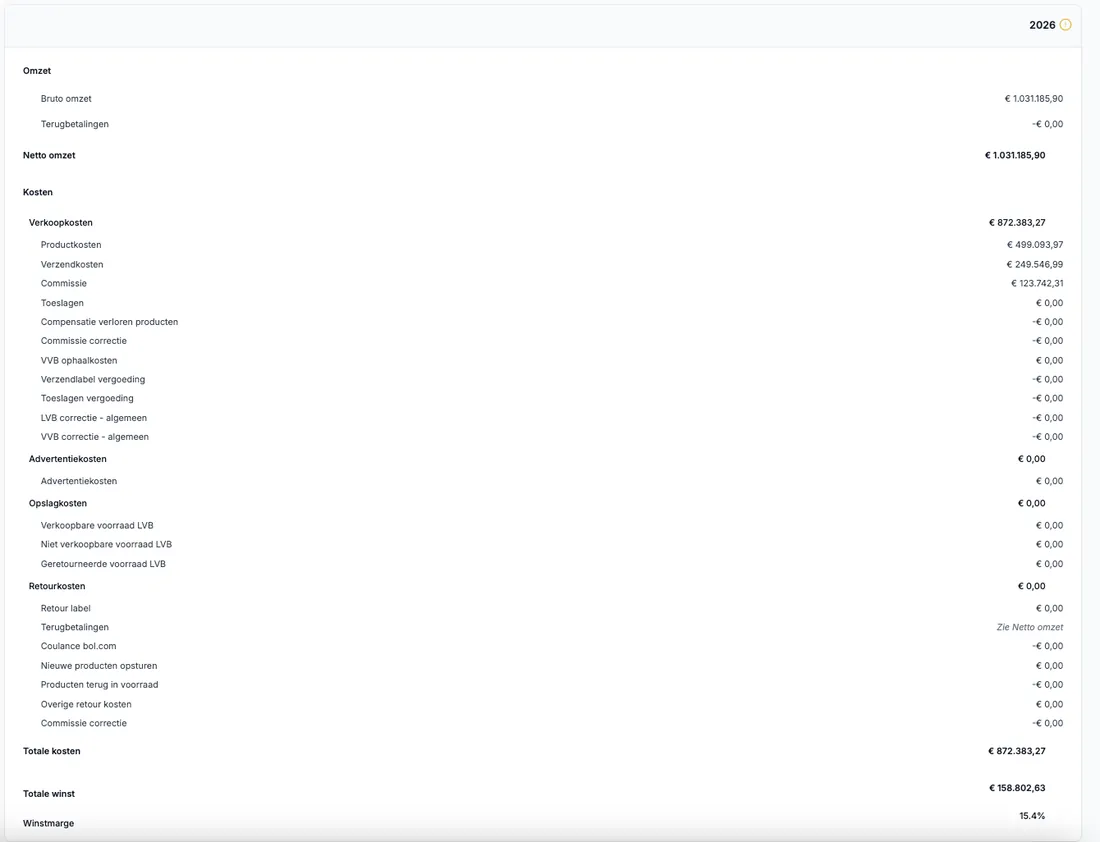
If you do not want to dig into it yourself every week, we send you reports on bestsellers, rankings and profitability, at the frequency you choose.
Store management: emails and invoices automated
That is where most time leaks away. In MarktMentor you manage your range and stock in one place, with purchase prices, low-stock warnings and a calculation of how many days of stock you have left. Customer Invoices are generated automatically, uploaded to bol and sent to business customers via Peppol.
Your VAT return on your bol revenue also takes more time than necessary, especially if you sell in several countries or at several VAT rates. In the VAT invoices you see per quarter your output VAT broken down by country and by rate, your deductible VAT per cost group such as commission and fulfilment, and the balance between them. We calculate that breakdown from the orders behind your bol invoices. Per invoice you see the source data and whether the data is complete, and you export the whole calculation for your accountant.
Invoices count towards the year and quarter of their issue date and not of the invoice period. That determines in which quarter an amount lands, and therefore whether your figures match the period you are filing your return for. Always have your VAT return checked by your accountant.
On the customer side, the review insights show your NPS and review scores across your whole range. But a score does not tell you what to change. That is why we extract the aspects from the review texts themselves: which strengths customers consistently mention, and where they keep running into problems. You can filter on such an aspect, and compare your own scores with those of comparable products. That turns "this product gets a 3.8" into a concrete pointer to what you need to change in the product or the listing.
With email campaigns you ask for reviews in a fair, neutral way, within the rules bol sets for this. You choose the moment, for example a number of days after delivery, and Dutch and French-speaking customers automatically get the right language.
Knowledge about selling on bol: current or outdated?
Tooling without knowledge will not get you far, and on bol that knowledge only lasts as long as the rules it rests on. When bol tightened its detection of the shopping cart method in November 2024, part of the common explanation of sales estimates became outdated in one go. The same applies to commission changes and new regulations such as GPSR. Course material that does not keep up with this teaches you something that is no longer correct.
That is why our Knowledge Base is updated continuously and is freely accessible, without an account. There you learn step by step how to sell your first product: finding suppliers and communicating with them, importing to the Netherlands, and which regulations you need to comply with. Through the MarktPraat podcast and our webinars we cover current developments with people who sell on bol themselves, so you hear what is changing now and not what applied last year.
There is also a free series on market research on bol on YouTube. Ten chapters, from common mistakes to profit calculation, in which two example products are followed from start to finish. No account needed, so you can first see whether selling on bol is for you.
Even as a beginner, you start from the situation as it is today, not the situation of a few years ago.
How a growing bol seller approaches this
In our documentary you follow TLS Commerce, the company behind top 50 brand Nuvance, from its first product research to €5 million in revenue on bol. You see which decisions they made, which data they based them on, and where things went wrong along the way.
Being honest about Zoloo
Zoloo is a serious platform with a broad feature set, and on the basics we cover comparable ground. On education they were ahead for a while; we have closed that gap with a Knowledge Base that is updated continuously, a free video series and the MarktPraat podcast and webinars with people who sell on bol themselves.
The difference shows when you move from tracking to analysing. Then you want to be able to cut through a market instead of saving products, see who wins the buy box and why, know whether a newcomer can still get in, see your organic position separately from what you buy, and have ads that adjust themselves based on that data. That is what MarktMentor is built for, and that is why sellers who are serious about growing on bol work with us.
Compare them on the points that weigh most heavily in your situation. 14 days free, full access, no payment obligation. Our rates are on the pricing page.