
How do Incoterms, import duties and VAT work when importing from China?
 Lars HurkmansCo-founder4 July 2023Reading time 5 minutes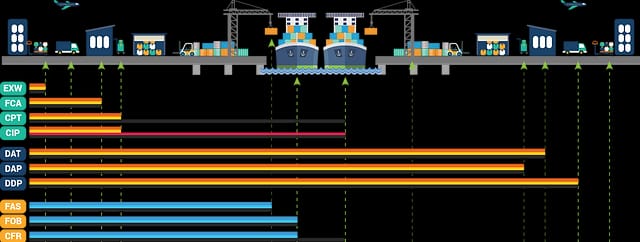
When importing from China, three things determine your costs and risks. Incoterms set out who arranges transport, insurance and customs, from EXW (you arrange almost everything) to DDP (your supplier arranges everything). You pay import duties on the customs value, at a rate that depends on the TARIC code. Import VAT is calculated on the customs value plus the import duties.
If you import goods from China, you'll deal with three things: the trade terms (Incoterms), import duties and VAT. Below we explain them one by one, with a calculation example and the rules as they currently stand. These terms come into play after you've chosen a supplier and placed your order; the full sourcing process before that is covered in our step-by-step plan for sourcing from China.
What are Incoterms and what do they cover?
Incoterms, or International Commercial Terms, are international rules that set out who is responsible for what in international trade. They're drawn up by the International Chamber of Commerce (ICC) and determine who arranges the transport and insurance of the goods, who handles the customs formalities, and who bears which costs.
Which Incoterms exist, from most to least responsibility for the importer?
There are eleven Incoterms in total. We've summarised the main ones here, from most to least responsibility for you as importer:
- EXW (Ex Works): with this term the importer carries the most responsibility. The seller only has to make the goods ready for shipment. The importer arranges and pays for the transport, insurance and customs formalities.
- FCA (Free Carrier): the seller delivers the goods to an agreed location, usually a warehouse. From that moment the costs and risks are for the importer.
- CPT (Carriage Paid To): just like with FCA the seller arranges the transport, but the insurance is the importer's responsibility.
- CIP (Carriage and Insurance Paid To): here the seller arranges the transport to a certain location and also pays for the insurance. The risks transfer to the importer as soon as the goods are delivered at the agreed location.
- DDP (Delivered Duty Paid): with this term the seller takes on almost all responsibility. They arrange the entire transport, pay all costs and are responsible for any damage or loss during transport. They also pay the import duties and VAT.
Which Incoterm you use is something you agree with your supplier. The transport and customs handling that go with it can be outsourced to a freight forwarder; what someone like that does for you is covered in the role of a freight forwarder and sourcing agent when importing from China.
What don't Incoterms cover?
Incoterms cover a lot, but not everything. There are a number of things they don't determine:
- They don't determine all the terms of a sale.
- They don't identify the goods being sold, and they don't state the contract price.
- They don't refer to the method or moment of payment negotiated between seller and buyer.
- They don't indicate when ownership of the goods transfers from the seller to the buyer.
How much import duty do you pay when importing from China?
How much import duty you pay depends on the product's TARIC code and the country of origin. If you import from outside the EU, such as from China, you generally pay import duties on the customs value. The EU has trade agreements with various countries; if you import from such a country, you often pay less import duty.
If you import products directly from a country with which the EU has a trade agreement, and those products have preferential origin from that treaty country, you often pay less or no import duty.
Watch out for small shipments. The old exemption from import duties for shipments up to 150 euros has lapsed: as of 1 July 2026 you also pay import duties on e-commerce shipments up to 150 euros (source: Dutch Customs). From 1 July 2026 to 1 July 2028 a fixed import duty of 3 euros per declaration line applies to that; from 1 July 2028 the normal EU rate per product category applies. This rule specifically concerns small e-commerce shipments that go from outside the EU directly to consumers in the EU. If you import a batch of stock to sell yourself, you pay import duties according to the TARIC code regardless.
Belgium has similar rules for import duties. For the most current and accurate information, contact your local customs authorities or a tax advisor.
How do you calculate import VAT when importing from China?
You calculate the import VAT on the customs value plus the import duties. The customs value is the price you as importer pay for the goods, plus the transport and insurance costs up to the EU border. In the Netherlands the rate is 21 percent.
A calculation example. Suppose you import a batch of toy cars from China for 8,000 euros. The transport and insurance costs to Rotterdam come to 1,500 euros. The customs value of your goods is then 9,500 euros. If the import duties in this example are 10 percent (the actual percentage depends on the TARIC code), you pay 950 euros in import duties. You then pay 21 percent import VAT on 10,450 euros, which is 2,194.50 euros.
Once you know your import duties and import VAT, you know your total cost price per unit. What you keep from that on bol, you calculate with the profit calculator.
Belgium has similar rules for import VAT, calculated on the customs value plus the import duties. The standard VAT rate there is 21 percent, with reduced rates for certain types of goods.
What do you remember about Incoterms, import duties and VAT?
Incoterms, import duties and VAT together determine who bears which risk and what your import ultimately costs. Incoterms set out the responsibilities between buyer and seller, import duties are paid on the customs value according to the TARIC code, and import VAT is calculated on the customs value plus those import duties. For every Dutch or Belgian entrepreneur importing from China, it's worth understanding these three: they give clarity and certainty for both buyer and seller.
Incoterms are revised roughly every ten years to keep pace with changes in international trade. The most recent version is Incoterms 2020. The explanation in this article is based on information from the Dutch Chamber of Commerce (KVK); always consult Customs or a tax advisor for your specific situation, especially now that the rules for small shipments are changing.
Which Incoterm and which price you agree on is something you negotiate with your supplier. How you find and approach suppliers is covered in sourcing on Alibaba, and how you're taken seriously at the table in how do you get taken seriously by Chinese suppliers.
Read more: